Factbook
Investments and Portfolio Measures
Portfolio management is a key element of our strategy: Our goal is to empower the core businesses and to realize the value of the standalone businesses. In addition, investments remain a significant driver of our targeted profitable growth as well as our green transformation. In this context, we focus on high-growth markets. The establishment of the new Verbund site in Zhanjiang, China, is an important step in achieving these goals.
Continuous investments in our plants provide the basis for achieving the organic growth we strive for in our core businesses. We invest in ensuring the safety of our production facilities and securing our license to operate. In addition, we are driving the use of new technologies to enable our own green transformation and that of our customers. At the same time, we are taking measures to increase the efficiency of existing production processes and thereby to improve the profitability and competitiveness of our operations. For the period 2026 to 2029 we are planning capital expenditures1 of around €13 billion. Having reached a record level of capital expenditures in 2024, mainly due to the establishment of the Verbund site in Zhanjiang, capital expenditures in 2025 were significantly below the prior-year figure at around €4 billion. For 2026, we anticipate a further decline to €3.3 billion; the investment volume is thus expected to be below the level of depreciation and amortization, as planned.
In the context of portfolio management, we want to further strengthen our core businesses through value-adding acquisitions. With regard to our standalone businesses, we are pursuing options to create the greatest value for BASF and its shareholders.
1 Additions to property, plant and equipment excluding acquisitions, restoration obligations, IT investments and right-of-use assets arising from leases
Investments in the segments
In 2025, investments in property, plant and equipment (including restoration obligations, IT investments and right-of-use assets arising from leases) amounted to €4,562 million (2024: €6,506 million). Capex accounted for €4,027 million of this amount (2024: €5,996 million). Our investments in 2025 focused on the Chemicals, Materials and Nutrition & Care segments.
Capex by segment 2026–2029

Investments in the regions
In 2025, we focused our investment projects on the expansion of our position in our three key regions: Asia Pacific, North America and Europe. The Asia Pacific region, especially China, is making a significant contribution to the growth of the global chemicals market with a market share of almost 70%. We expect that over 80% of growth in the chemical industry will be concentrated in this region by 2035. By establishing our new integrated Verbund site in Zhanjiang we aim to participate in this development and serve the increasing demand from various growth industries in this region. We manufactured the first products from the Verbund there in November 2025. Commissioning of the steam cracker commenced at the end of December 2025. We also continuously invest in the ongoing development of our other Asian sites.
The expansion of our production capacities in the isocyanates value chain in Geismar, Louisiana, BASF’s largest own investment in North America, remains on schedule and is set for startup in 2026. This will increase BASF’s production capacity for methylene diphenyl diisocyanate (MDI) in North America from 380,000 metric tons per year to around 600,000 metric tons per year.
We are also strengthening our sites in Europe. At the Verbund site in Ludwigshafen, for example, we have started construction of a new production plant for semiconductor-grade sulfuric acid as well as a new plant for electronic-grade ammonium hydroxide. After the planned startups of the plants in 2027, the new capacities are expected to meet the growing demand from the European semiconductor industry while strengthening the resilience of supply chains in this sector.
Capex by region 2026–2029

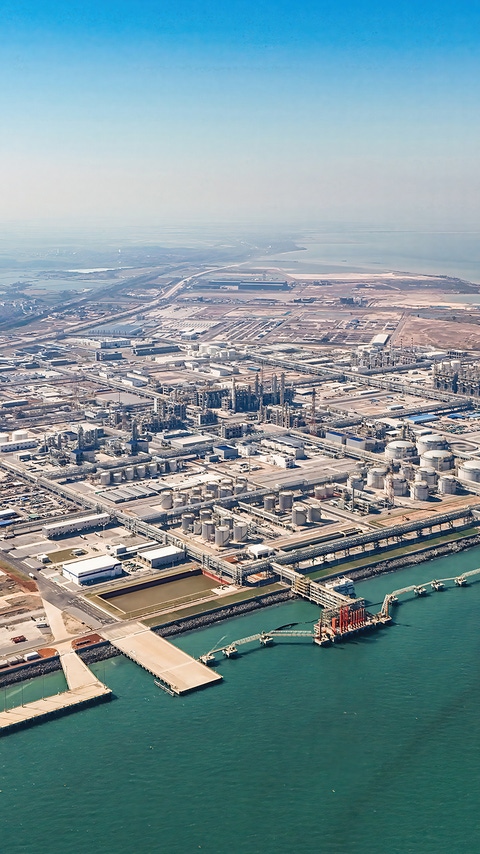
New Verbund site in Zhanjiang

In recent years, market growth in China has been driven by rising domestic consumption, higher standards of living as well as more local value creation. With a global market share of more than 50%, China is the largest chemical market and drives the growth of global chemical production. BASF wants to participate in this growth and has built an extensive network throughout the country:
- Shanghai is home to our Greater China headquarters, one of our two Innovation Campuses in the Asia Pacific region as well as our Caojing production site.
- Nanjing is the location of our joint venture Verbund site with Sinopec as well as a wholly owned site.
- In Chongqing, we operate a wholly owned MDI production complex.
- Our new fully owned Verbund site in Zhanjiang is BASF’s thirdlargest Verbund site globally.
As of December 31, 2025, BASF had 12,452 employees in Greater China, 29 major wholly owned subsidiaries, 11 major joint ventures and 29 production sites. In 2025, BASF posted sales of approximately €8.2 billion1 to customers in Greater China.
1 Excluding the discontinued coatings business
Guangdong is home to key customers from fast-growing industries

Market characteristics5
-
Nearly 128 million residents in Guangdong province (2025)
-
GDP Guangdong (2025): ~$2.26 trillion
-
GDP CAGR 2025–2040: ~4.4% p.a.
-
Key customer industries: transportation, consumer goods, home and personal care, electronics
-
Chemical products are generally undersupplied from local production
1 Industry real output, 2021-based, Guangdong Bureau of Statistics
2 Real chemical gross output, 2021-based, inferred by gross output/value added ratio for China, Guangdong Bureau of Statistics
3 Plastics in primary forms, Guandong Bureau of Statistics
4 Real private consumption, 2021-based. S&P Global and BASF revised estimate
5 Guangdong Bureau of Statistics, S&P Global
With around 128 million residents, Guangdong is the most populous province in China. The province is the economic powerhouse of China and accounted for more than 10% of the country’s GDP in 2025. Guangdong province is home to many BASF customers in fast-growing industries such as transportation, consumer goods, home and personal care, and electronics. Zhanjiang has a deepwater seaport with easy access to shipments of raw materials and finished goods to and from other ports in China, Asia and other regions. It also offers the shortest sea routes between mainland China and Southeast Asia. The government of Guangdong province is committed to providing this area with world-class infrastructure.
To accelerate the company’s growth in Asia, BASF announced the Zhanjiang Verbund site project in 2018 and laid the foundation stone the following year. The first production plant to begin operation at the Zhanjiang site was for engineering plastics in 2022; it was followed by a thermoplastic polyurethane plant in 2024. At the turn of 2025/2026, BASF began production in the first value chains in the Verbund and successfully ramped up the world-scale flex-feed steam cracker, which can use both naphtha and butane as feedstocks. The project has been accomplished on schedule and well below the original budget, with total investments of around €8.7 billion in the period 2019 to 2028.
As of the first quarter of 2026, BASF has successfully started up 18 plants, 32 production lines, and is producing more than 70 products in Zhanjiang. With the proven Verbund concept with long value chains, BASF offers a broad, highly diversified product portfolio from its Chemicals, Materials and Nutrition & Care segments for the transportation, consumer goods, electronics, home care and personal care industries. Covering an area of around four square kilometers, BASF’s Zhanjiang site employs over 2,000 people.
The Zhanjiang Verbund site also sets new benchmarks for sustainable chemical production, both in China and worldwide. The site has been supplied with 100% renewable electricity since the beginning of 2025. As BASF’s first implementation of a fully digital smart Verbund concept in a large-scale project globally, the site has been built on the basis of cutting-edge technologies that maximize resource and energy efficiency and reduce environmental impact. Circular economy concepts have been incorporated to support customers in the region with low-emission solutions.
Acquisitions
On July 1, 2025, BASF completed the purchase of the 49% stake held by DOMO Chemicals GmbH, Leuna, Germany, in the Alsachimie S.A.S. joint operation in Chalampé, France, which had been announced on May 28, 2025. BASF had held 51% of the joint operation prior to the transaction. Full ownership of Alsachimie enables BASF to optimize backward integration of key raw materials, ensuring supply reliability and efficiency across the polyamide 6.6 value chain.
On March 31, 2026, BASF Agricultural Solutions successfully closed its acquisition of AgBiTech. This follows the agreement with private equity firm Paine Schwartz Partners and other shareholders signed in January 2026, and the receipt of all necessary regulatory approvals. The acquisition is expected to enable faster scaling and broader adoption of biological solutions and reinforces BASF’s commitment to offer farmers more effective and diversified insect control options.
Divestitures
On March 25, 2025, BASF and Vattenfall announced the sale of BASF’s 49% equity share in the Nordlicht 1 and 2 wind farm projects to Vattenfall. The collaboration with Vattenfall will continue, securing BASF a long-term supply of electricity from renewable sources for its chemical production in Europe – at a later point in time when additional green electricity is needed.
Effective April 21, 2025, BASF completed the divestiture of its shares in BASF Markor Chemical Manufacturing (Xinjiang) Co., Ltd. and Markor Meiou Chemical (Xinjiang) Co. Ltd. in Korla, China, to Verde Chemical Singapore Pte. Ltd. The companies operated production plants for butanediol and PolyTHF, which were allocated to the Chemicals segment. The assets and liabilities allocated to the disposal group were derecognized in April 2025.
On September 30, 2025, BASF successfully completed the sale of the food and health performance ingredients business to the Louis Dreyfus Company (LDC), Rotterdam, Netherlands. This transaction included the production site in Illertissen, Germany, three application laboratories outside Germany and around 300 employees. The transferred business activities were part of the Nutrition & Health division and include food performance ingredients, health ingredients and several smaller product lines.
After approval by the responsible competition authority, BASF completed the sale of its Brazilian decorative paints business to Sherwin-Williams, Cleveland, Ohio, on October 1, 2025. On a cash and debt-free basis, the purchase price amounted to $1.15 billion (€981 million). The transaction included the Brazilian production sites in Demarchi and Jaboatão, related contracts, the Suvinil and Glasu! brands, and the transfer of approximately 1,000 employees. The decorative paints business, which was part of the Coatings division in the Surface Technologies segment, generated sales of around €485 million in 2024 and operated almost exclusively in Brazil.
The sale of BASF’s optical brightening agent business to Catexel was completed effective March 1, 2026. Optical brightening agents are ingredients in laundry detergent formulations. Both parties have agreed to keep the financial details of the transaction confidential. The transaction comprises the international business including the production of optical brightening agents at the Monthey site in Switzerland. As part of the divestment, around 80 employees transferred to Catexel.
Agreed transactions
On October 10, 2025, BASF and Carlyle, Washington D.C., announced they had signed a binding agreement for the sale of BASF’s automotive OEM coatings, automotive refinish coatings and surface treatment business units (“coatings”). The enterprise value of the transaction amounts to €7.7 billion. Subject to approval from the relevant regulatory bodies, the transaction is expected to close in the second quarter of 2026. Upon closing, BASF will receive pretax cash proceeds of approximately €5.8 billion as well as a 40% equity stake in the new coatings entity, which it will report as a financial investment accounted for using the equity method.
The business to be divested generated sales of around €3.7 billion in 2025. Owing to the planned divestiture, the affected business units are reported as discontinued operations in accordance with IFRS 5 as of September 30, 2025. From this date, the sales and earnings of the automotive OEM coatings, automotive refinish coatings and surface treatment business units will no longer be part of the sales and EBIT(DA) of the BASF Group or the Surface Technologies segment. Retroactively to January 1, 2025, and until the transaction closes, the income after taxes of these business units is presented in the income after taxes of BASF Group as a separate item (income after taxes from discontinued operations). The 2024 figures have been restated accordingly. The decorative paints business was not affected by this retroactive restatement and remained part of the Surface Technologies segment until the divestiture on October 1, 2025.